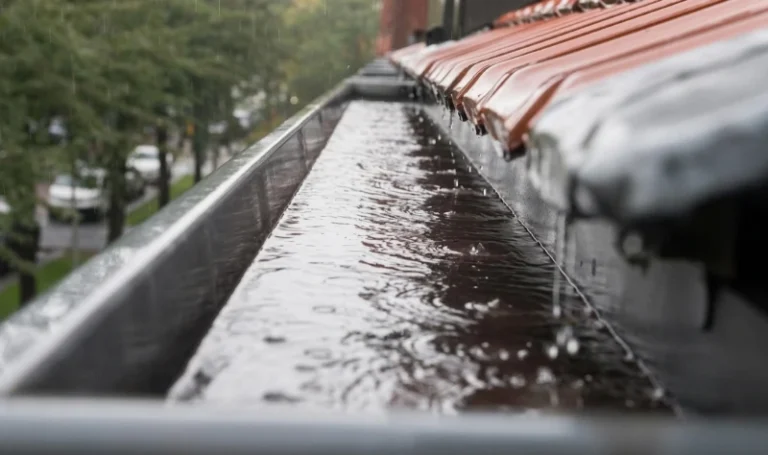

Why Is Water Leaking Behind Your Gutters?
Your gutters aren’t clogged. You just cleaned them, or they never had much debris to begin with, and water is still running down the siding or fascia instead of into the trough. This is a different problem than overflow, and it’s one almost nobody writes about clearly. Here’s what’s actually happening when water leaks behind a clean gutter, and what fixes it.
This Isn’t the Same Problem as Overflow
Overflow happens when a gutter fills up faster than it can drain, debris, a clogged downspout, too much water for the pitch. Water leaking behind the gutter is mechanically different: the gutter itself may be completely empty and draining fine, but water never makes it into the trough at all. Instead, it clings to the underside of the roof edge or shingle and runs down behind the gutter, straight onto the fascia board or siding. Cleaning the gutter harder doesn’t fix this, because the gutter was never the problem.
What’s Actually Happening: Capillary Action and the Drip Edge
Water doesn’t just fall in a straight line off a roof edge, it clings to surfaces through capillary action, the same effect that pulls water up a paper towel. Without something to break that surface tension and force water to drop cleanly into the gutter, it follows the underside of the shingle or roof deck backward and drips down behind the gutter instead of into it. A metal drip edge, installed correctly under the shingles and over the back of the gutter, is what’s supposed to break that capillary pull. When it’s missing, damaged, or installed at the wrong angle, water bridges the gap and ends up exactly where you don’t want it. For definitions of terms like drip edge, fascia, and pitch, see our glossary of gutter and drainage terminology.
The Real Causes, in Order of How Often We See Them
Missing or damaged drip edge
The most common cause by far. Some older Roseville homes were built or re-roofed without a drip edge at all, or with one that’s rusted through or bent away from the roofline. Without it, there’s nothing forcing water to release cleanly into the gutter.
Gutter pulled away from the fascia
If gutter hangers have loosened over time, even a small gap opens up between the back of the gutter and the fascia board. Water that would normally drop straight down into the trough instead finds that gap and runs behind it, a problem that gets worse gradually and is easy to miss from the ground.
Improper gutter pitch or mounting height
A gutter mounted too low relative to the roofline, or angled wrong, can sit outside the natural path water takes off the roof edge, so water overshoots the front lip of the gutter or misses the back edge entirely depending on wind and flow rate.
Insufficient shingle overhang
Shingles are supposed to overhang the roof deck by a small, specific margin so water drips clear of the fascia. If a roofing job trimmed them too short, or wind and age have curled the edge upward, water runs back along the underside instead of dripping forward.
How to Tell If This Is Your Problem
During the next rain, or with a hose, watch the roofline directly, not just the gutter. If you see water clinging to the underside of the shingle and dripping down behind the gutter rather than falling forward into it, that’s the capillary/drip-edge problem, not a clog. A dry, empty gutter with wet fascia or siding underneath it is the clearest sign: the gutter is doing its job, the water just never got there. If you’re still unsure, our gutter cleaning FAQ covers how to tell overflow apart from other roofline issues.
The Fix
Depending on the cause, the fix is usually one of: installing or replacing a proper metal drip edge under the shingle and over the gutter’s back lip, re-hanging the gutter tight against the fascia to close the gap, adjusting the gutter’s mounting height or pitch, or trimming and sealing shingle overhang so it directs water forward instead of back. None of these require replacing the whole gutter system, but they do require an actual gutter repair inspection of the roofline and gutter-to-fascia connection, not just a look from the ground.
Why This Problem Gets Overlooked
Most gutter cleaning visits check for clogs and debris, not for a gap between the gutter and fascia or a missing drip edge, because those aren’t cleaning issues. A homeowner who’s already had gutters “cleaned” and is still seeing water damage understandably assumes the cleaning didn’t work, when the actual problem was never inside the gutter at all. If your gutters are empty and clean but you’re still seeing staining, rot, or water at the fascia line, this is worth mentioning specifically when you book an inspection. It’s a different failure mode than the damage covered in what happens when gutters are neglected long-term, but it leads to the same fascia and roofline damage if it’s left unaddressed.
Not sure if this is a drip edge problem or something else? We’ll inspect the roofline and gutter-to-fascia connection and tell you exactly what’s going on, see our gutter repair services or call directly.
Water Behind the Gutter FAQ
Why is water leaking behind my gutter instead of into it?
Water clings to the roof edge through capillary action and needs a drip edge to break that pull and release cleanly into the gutter. If the drip edge is missing, damaged, or the gutter has pulled away from the fascia, water runs down behind the gutter instead of dropping into it.
Is water behind the gutter the same problem as gutter overflow?
No. Overflow happens when a gutter fills faster than it drains, usually from clogs. Water behind the gutter can happen even when the gutter is completely empty and clean, because the water never made it into the trough in the first place.
What is a drip edge, and why does it matter?
A drip edge is a thin metal flashing installed under the shingles and over the back lip of the gutter. It forces water to drop cleanly off the roof edge into the gutter instead of clinging to the underside of the shingle and running behind the gutter.
Can a gutter cleaning fix water leaking behind the gutter?
No. This isn’t a debris or clog issue, so cleaning won’t resolve it. The fix requires addressing the drip edge, the gutter’s attachment to the fascia, its pitch, or shingle overhang, whichever is actually causing the gap.
How do I check if my home has this problem?
During rain or with a hose, watch the roofline itself rather than the gutter. If water clings to the underside of the shingle and drips down behind the gutter instead of falling into it, or the gutter stays dry while the fascia gets wet, that’s the sign to look for.